Research project · First author
Virtual Roads,
Smarter Safety
A physics-aware digital twin for testing autonomous vehicles in mixed traffic before the hard cases reach public roads.
I developed a field-to-simulation workflow that reconstructs real roads, synchronizes traffic and autonomous-vehicle behavior, models tire and vehicle dynamics, and turns each run into measurable safety evidence.
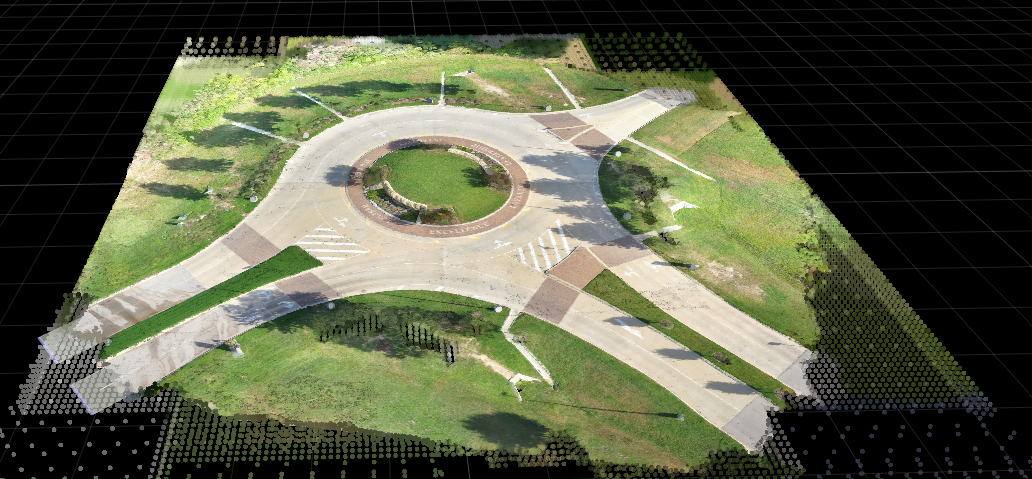
01
The problem
Safety metrics are only as credible as the world behind them.
Crash records tell us what already failed. Public-road testing cannot efficiently cover rare, dangerous events. And conventional time-to-collision calculations often flatten the problem to constant speed and one-dimensional motion.
Those shortcuts can omit the factors that decide whether an AV stops safely: road slope, intersection geometry, tire friction, mass distribution, steering, suspension, and the behavior of surrounding traffic.
The design goal was end-to-end fidelity: realistic roads, realistic traffic, realistic vehicle physics, and a risk measure that connects them.
02
The system
One synchronized pipeline connects the physical road to the safety metric.
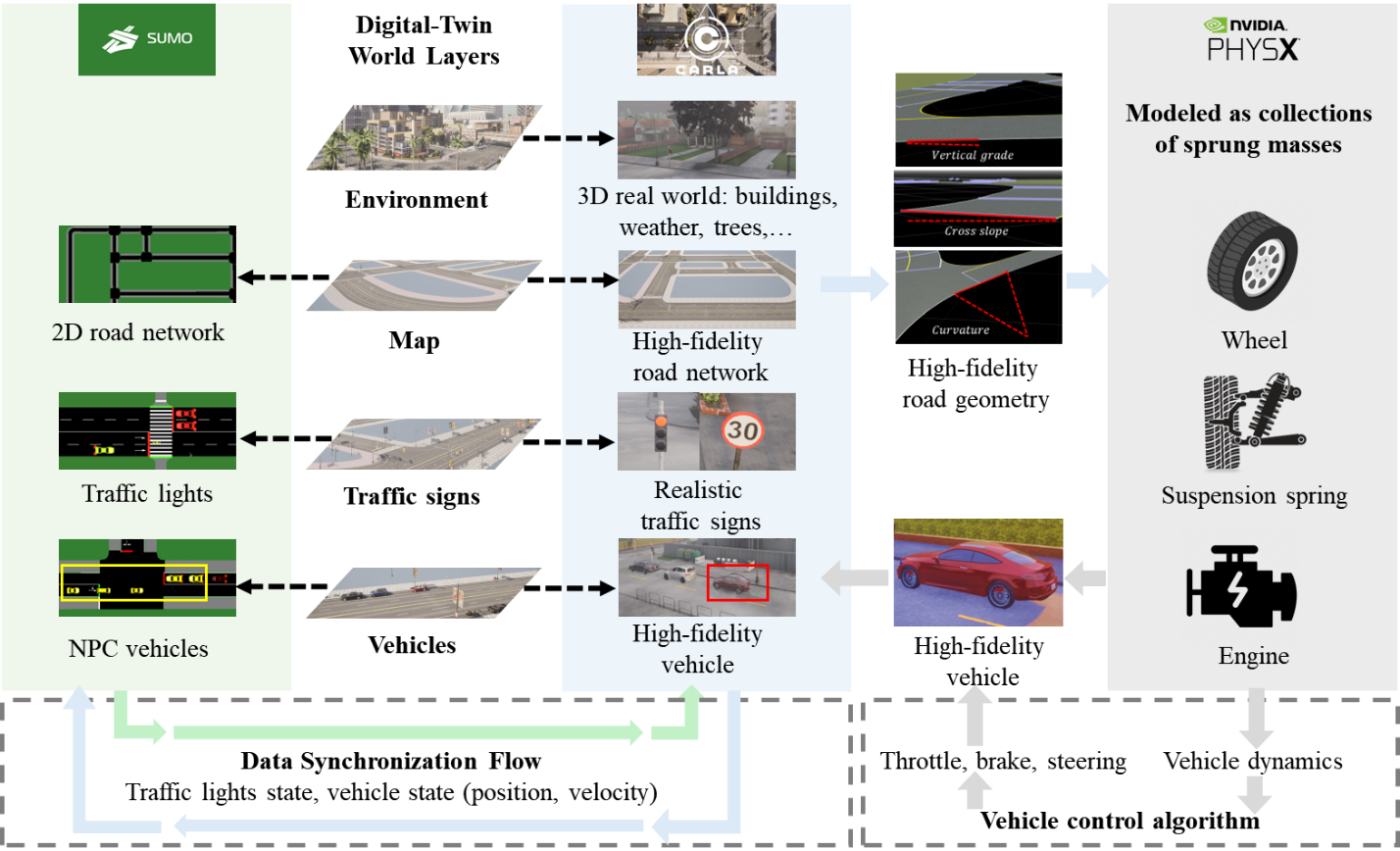
Reconstruct the environment
Aerial LiDAR and OSM establish the scene; GPS and inclinometer measurements refine slope, superelevation, and curvature.
Run mixed traffic
SUMO controls network-scale traffic and signals while CARLA hosts the ego vehicle, sensors, environment, and custom AV logic.
Measure what changes risk
PhysX resolves wheel and tire forces; the safety layer evaluates collision risk in the full three-dimensional scene.
03
Environment reconstruction
Build the road at the fidelity the vehicle will feel.
The platform combines complementary sources instead of asking one dataset to do everything. OSM supplies accessible network structure, aerial LiDAR captures the physical scene, and vehicle-mounted sensors recover roadway attributes that influence dynamics.
- Semantic segmentation separates roads, buildings, and vegetation in the point cloud.
- RoadRunner converts the georeferenced scene into OpenDRIVE and simulation assets.
- GPS and inclinometer data sampled at 5 Hz refine curvature, slope, and cross-slope.
- DBSCAN-based junction assignment repairs missing intersection connections.
Watch the real-to-digital step
Capture once. Reuse the environment across AV experiments.
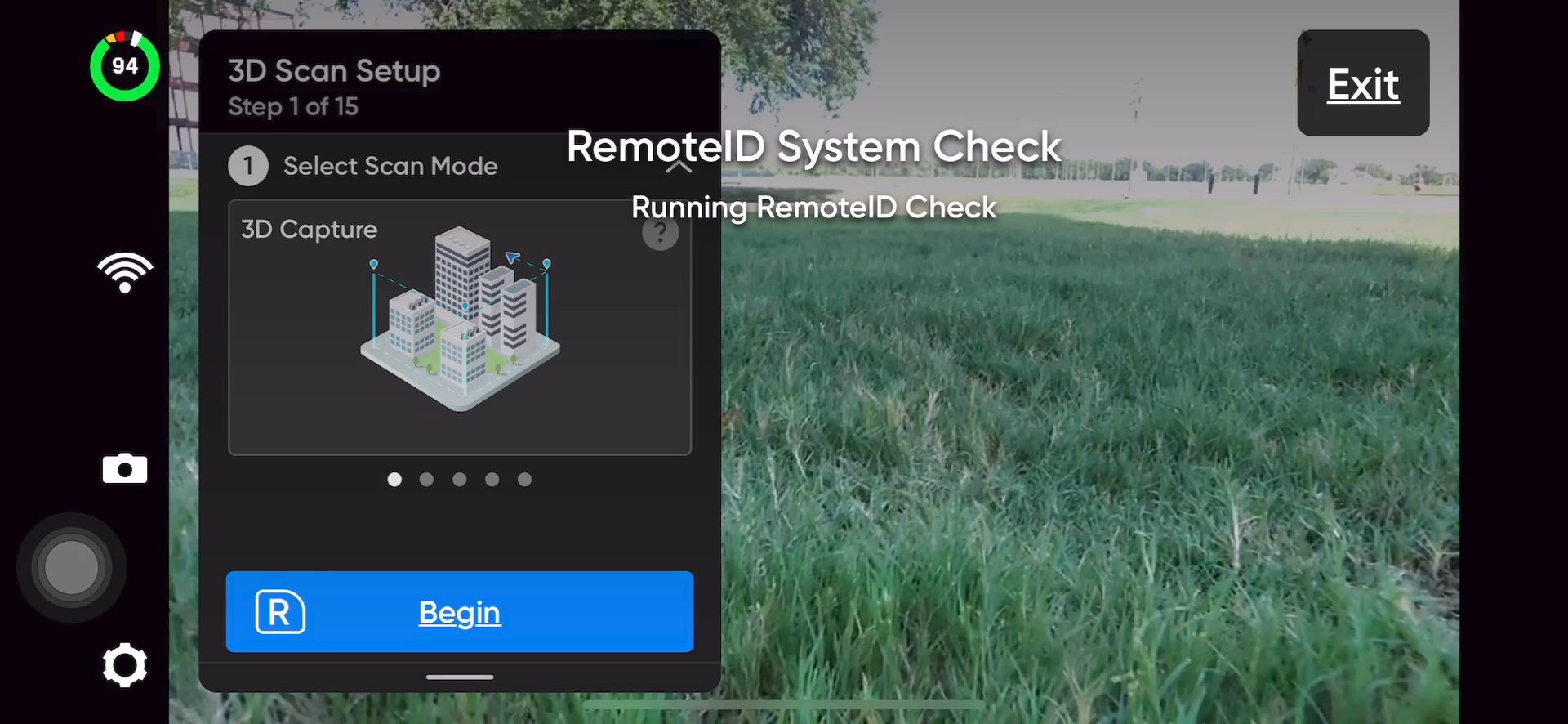
The drone follows a structured scan plan to collect overlapping multi-view imagery. Ground control points anchor the reconstruction to real coordinates so the resulting geometry can be aligned with OSM and exported to the simulation stack.
 01
Collect
Drone multi-view images establish the scene; ground control points and GPS provide geospatial reference.
Output · raw .dng imagery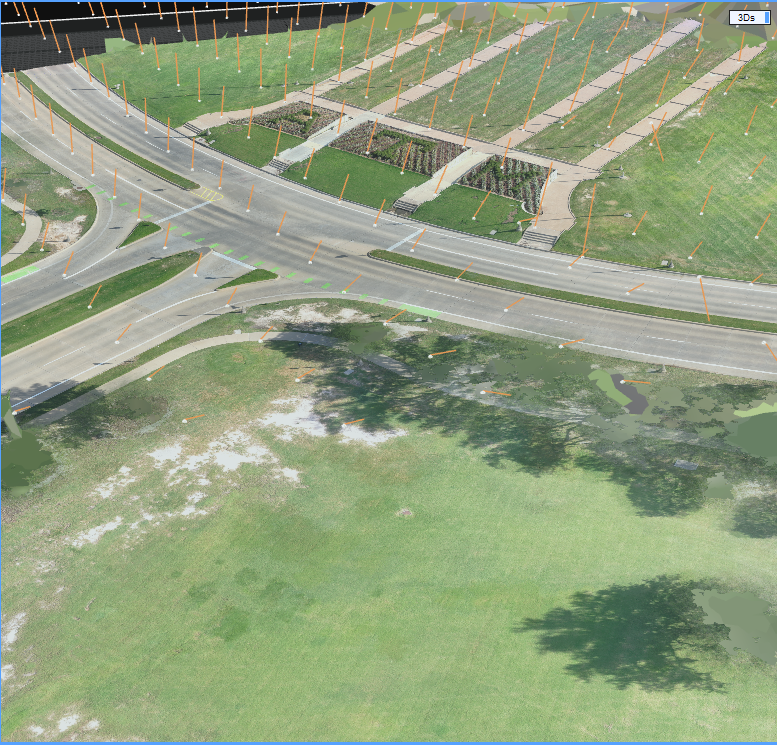 02
Reconstruct
RealityCapture aligns the images and produces a dense, georeferenced 3D point cloud and textured mesh.
Output · .las point cloud03Structure
Semantic segmentation and OSM add roads, lanes, topology, buildings, vegetation, and junction logic in RoadRunner.
Output · .rrhd scene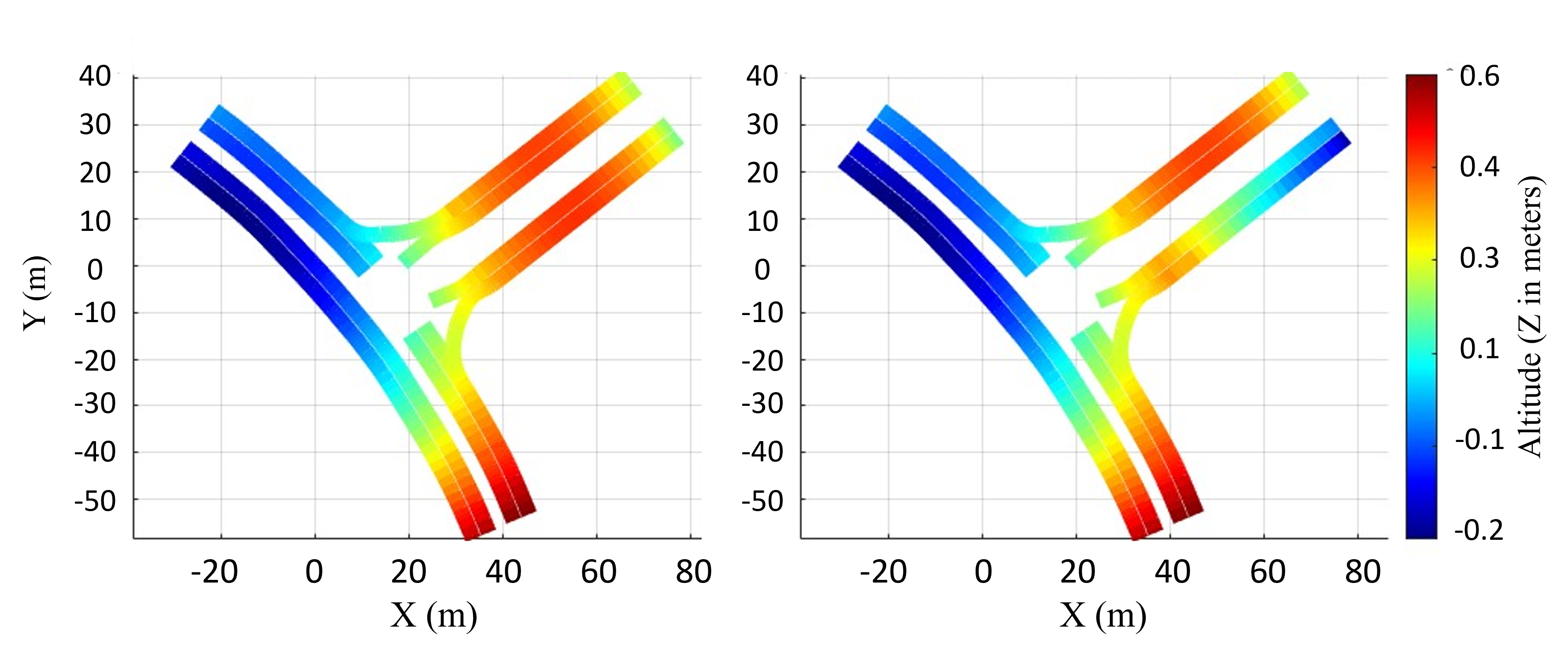 04
Calibrate & export
Vehicle sensors refine grade and cross-slope; missing junctions are repaired before synchronized deployment.
Output · OpenDRIVE + CARLA/SUMO assets04
High-risk scenario testing
Risk is designed into the road, then tested under live traffic.
ASAM OpenDRIVE gives the platform a parametric description of roads, lanes, markings, objects, and signals. That lets us create repeatable safety-critical tests by changing the infrastructure geometry itself—not just the actors moving through it.
Start from a reusable road template, modify the safety-critical geometric parameter, and deploy the resulting network into the digital twin.
Choose an OpenDRIVE lane drop, on-ramp, or weaving interface.
Shorten the taper, acceleration lane, or distance between entry and exit.
Generate the network, add traffic, and observe vehicle behavior and safety telemetry.
Lane drop with insufficient taper
A standard 2-to-1 lane-merge template is modified by suppressing the taper length below the safe transition threshold for the design speed.
Parameter Ltaper · abrupt lateral compressionShort on-ramp acceleration
The acceleration lane is constrained so an entering vehicle cannot reasonably accelerate from roughly 40 mph to the 60+ mph mainline speed before merging.
Parameter Laccel · closing-speed conflictHeavy weaving section
An on-ramp is placed immediately before an off-ramp, compressing the distance available for entering and exiting vehicles to cross paths.
Parameter Lweave · concentrated lane-change conflictsThese are geometry-controlled tests: each hazard can be reproduced, varied, and compared while the platform records the same simulation and safety channels.
05
Physics experiment
The same control input can produce a different safety outcome.
With throttle held at 0.5, the demonstration changes the tire-friction scaling factor from 5.0 to 1.0. The synchronized view exposes the resulting wheel forces, slip behavior, and vehicle spacing—not just the rendered motion.
Use the controls to compare the two runs.
06
Safety evaluation
Simulation becomes engineering evidence when the metric tracks the physics.
The paper evaluates eight synthetic collision scenarios spanning rear-end, sideswipe, blind-spot, and intersection conflicts. It compares traditional TTC with simulated collision time and a high-fidelity TTC that accounts for multidimensional motion and roadway effects.
That is a 59% reduction in MAE and a 67% reduction in RMSE in the paper's reported comparison.
07
My contribution
I worked across the stack—from infrastructure data to AV safety analysis.
Digital-twin construction
Built HD environments from LiDAR point clouds, OpenStreetMap, RoadRunner, and vehicle-sensor data.
Python co-simulation
Integrated CARLA, SUMO, and NVIDIA PhysX into a synchronized mixed-traffic analysis platform.
Safety experiments
Connected controllable scenarios and physics parameters to multidimensional collision-risk evaluation.
Research leadership
Led the first-author paper that brings mapping, transportation simulation, vehicle dynamics, and safety into one system.
Industry relevance
Transportation context is an advantage for autonomous-driving validation.
This work shows how I approach AV systems: the vehicle, road, traffic stream, infrastructure, and safety metric are coupled parts of one engineering problem.
- Reproducible rare-event testing
- Infrastructure-aware scenario design
- Physics sensitivity analysis
- Extensible control and sensor evaluation
Publication
H. Zhang, X. Yue, K. Tian, S. Li, K. Wu, Z. Li, D. Lord, and Y. Zhou, “Virtual Roads, Smarter Safety: A Digital Twin Framework for Mixed Autonomous Traffic Safety Analysis,” IEEE Internet of Things Journal.
Paper and citationLet's connect